

Oil giant Eni and jet fuel seller Neste among biofuels makers that bought from suppliers targeted by fraud investigation
Indonesian companies targeted in a palm oil fraud probe supplied European firms including Italian energy giant Eni and Finnish sustainable aviation fuel leader Neste, an investigation by SourceMaterial and AFP has found.
Police last month detained 11 people on suspicion of bribing officials to help them disguise palm oil as a less strictly regulated byproduct called palm oil mill effluent, or POME, Indonesia’s attorney general’s office said.
There is no suggestion that Eni, Neste or other companies supplied by the Indonesian businesses implicated in the probe had knowledge of or involvement in any wrongdoing.
Biofuels are a cornerstone of the European Union’s climate strategy that aims to power 29 per cent of cars and planes with ‘green’ energy by 2030. But they can also cause environmental damage and both Eni and Neste have promised to stop importing palm oil because of links to deforestation.
The arrests raise questions about buyers and regulators’ ability to detect fraud and stand by their environmental commitments, said Cian Delaney of Transport & Environment, a campaign group.
“Verification and certification of these imports is clearly failing,” he said. “European Union climate policy that is supposed to promote green fuels is being cheated.”
“EU climate policy that is supposed to promote green fuels is being cheated.”
An Eni spokeswoman said that all of the 21 consignments it received from Green Product International, one of the Indonesian suppliers named by police, contained POME, not palm oil. Eni has “a zero-tolerance policy for regulatory breaches” and immediately suspended all connections with the companies involved, she said.

Neste also removed Green Product International from its supply chain the day after the arrests and “continues to monitor the developments related to the case”, the company said in an emailed statement.
Even before the arrests, the Indonesian government had long suspected fraud in the POME industry. In January 2025 it temporarily suspended approvals for new POME exports after trade statistics appeared to show that the country was exporting 10 times more than it could produce.
Some EU states have already acted to prevent palm oil fraud. Last year Ireland’s government restricted the classification of any palm oil products, including POME, as “renewable fuel” because of verification issues. A similar German moratorium comes into force next year.
Verification has now become so problematic that buyers and regulators should be suspicious of any shipment marked as POME, said James Cogan, head of public policy at ClonBio, an Irish biofuel maker.
“I would challenge any POME or POME-based biofuels processor to publish their volumes, sources and paperwork, to allow public and independent scrutiny,” he said.
POME claims
Indonesian authorities accuse a Green Product International shareholder called Tony (many Indonesians have only one name) of fraudulently mislabelling palm oil as POME.
A person who answered a telephone call to Tanimas Edible Oils, which shares an office with Green Product International and where Tony is also a shareholder, confirmed that he had been arrested and declined to comment further.
Green Product International “sources or stores products” from Tanimas, which has also been removed from Neste’s supply chain, according to Neste’s statement. Neste tested its shipments from Green Product International and found them “consistent with palm-derived waste and residues and not with the typical profile of crude palm oil”, the statement said.
“Neste has taken the risk of fraud very seriously already for years and has developed robust methods to mitigate fraud risk,” the Neste statement said.
Between 2023 and 2025, Green Product International was the leading Indonesian supplier of palm oil products to Eni, with the most recent shipment in October, data shows. In the same period it sent at least 27 cargoes to Neste, the Finnish aircraft fuel supplier, as well as two to Kolmar, a Swiss trader, and one each to Cargill, the US commodities multinational, and Repsol, the Spanish oil major.

There is no suggestion that any of the recipients were involved in or had knowledge of any fraudulent activity.
Eni’s spokeswoman said that all of its POME purchases, including those it made from Green Product International through a third-party contractor, are certified under Italian law and by International Sustainability and Carbon Certification, or ISCC.
ISCC is a major EU-certified verifier of the bloc’s imports of palm oil products for biofuels.
A spokesperson for ISCC said that one of Eni and Cargill’s suppliers targeted by the investigation is “currently excluded from recertification” and another was “previously excluded”.
Green Product International still holds a valid certificate, according to the ISCC’s online registry.
An official at Indonesia’s attorney general’s office confirmed on 4 March that Tony was still in custody along with two other men, Van Ricardo and Erwin, directors of Surya Inti Primakarya and Bumi Mulia Makmur.
Signed customs documents and trade data record Van Ricardo and Erwin’s companies as suppliers of POME to Eni and Cargill in 2023 and 2024.
Neither Surya Inti Primakarya nor Bumi Mulia Makmur responded to calls or messages requesting comment.
Orangutan capital
The northern end of the island of Sumatra, where Green Product International has its headquarters, contains some of the world’s most deforested regions. It is also the only place where Sumatran orangutans, rhinos, Asian elephants and tigers still live together in the wild.
Its Tripa peatland, once known as “the orangutan capital of the world”, has shrunk by 86 per cent since the turn of the millennium as the forest is razed for palm plantations. An orangutan population of 60,000 in the 1980s has dwindled to about 30 today, according to Ian Singleton, conservation manager at Orangutan Haven in North Sumatra.

“It’s devastating,” he said. “Once you chop the forest down, the orangutans have nowhere to live.”
Tony, the arrested shareholder of Green Product International, and a second Green Product International director, are also directors of another company in the region, Inno-Wangsa Oils & Fats.
In November 2022, Inno-Wangsa bought palm oil from two companies that had drained peatlands and cut down rainforest in Tripa, according to documents obtained by Rainforest Action Network, a campaign group.
While much of the felling was legal, both suppliers were fined by the government in 2014 and 2018 for burning forests. That punishment has done little to stem the destruction, said Singleton.
Images collected by Nusantara Atlas show the extent of the deforestation at the SPS II concession
“We were really proud of getting those convictions,” he said. “But on the ground it didn’t really make a lot of difference.”
Satellite images reviewed by SourceMaterial show that deforestation in the site operated by one of the companies from which Inno-Wangsa bought palm oil, SPS II, was amongst the highest in Indonesia in the last year.
Verification challenge
Brussels has set targets requiring airports to make at least 70 per cent of aviation fuel ‘sustainable’ by 2050 and companies like Eni and Neste hope to supply much of that market.
Eni processes around one million tonnes of biofuels feedstock annually and last year signed a five-year deal to supply Ryanair with up to 100,000 tonnes of sustainable aviation fuel.
Neste already supplies jet fuel to some of the world’s biggest airports, including Schiphol in Amsterdam, Los Angeles International and Singapore, and in October extended a multi-year deal with United Airlines.
If deforestation-linked palm oil enters European supply chains, the climate benefits claimed for biofuels may be undermined, said Delaney of Transport & Environment.
“Disguising palm oil as waste products like POME has been far too easy,” he said. “The EU cannot keep relying on the current system.”
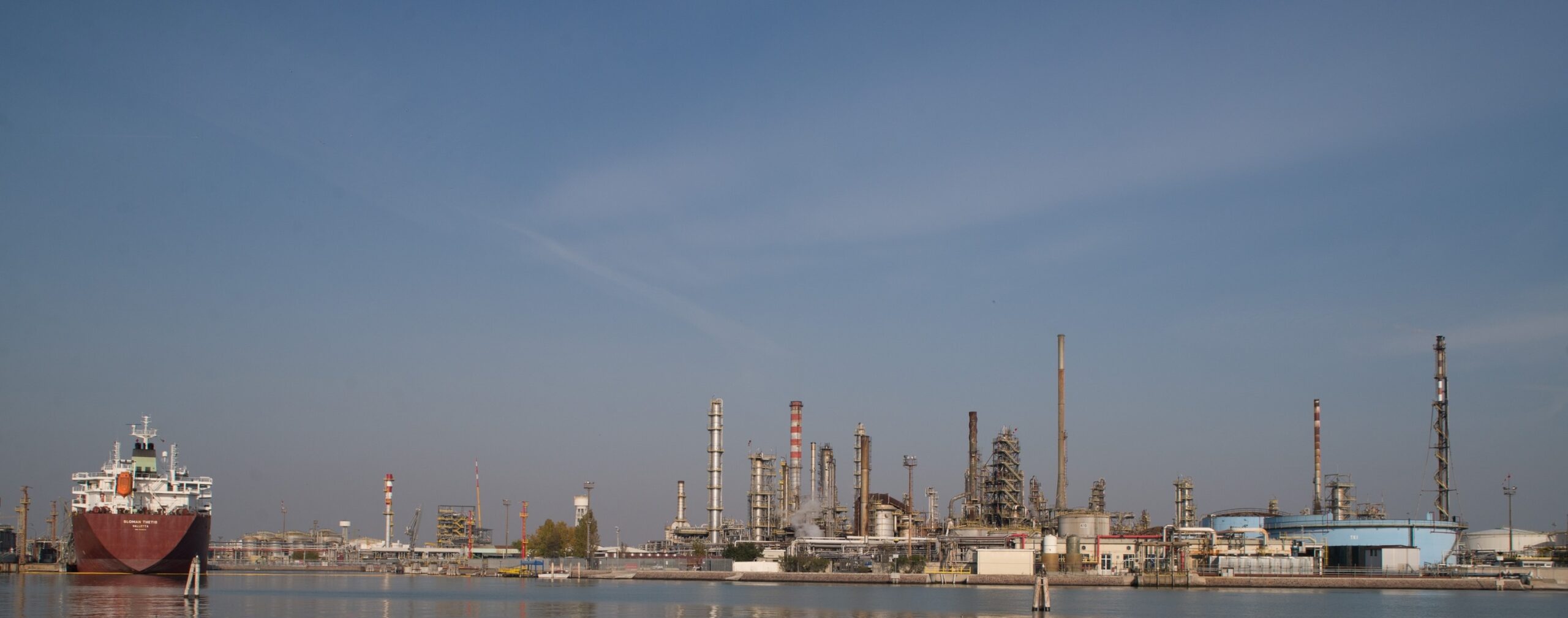
Headline picture: Eni’s biorefinery in Venice (Eni)